
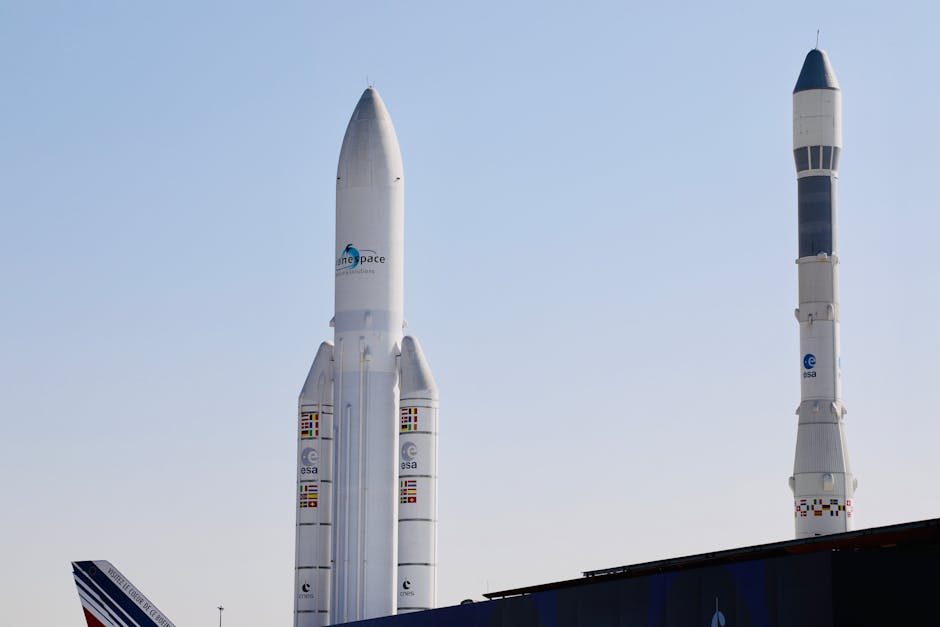
The European Space Agency has successfully launched the SMILE satellite from the Guiana Space Centre in French Guiana, marking a significant milestone in understanding how solar winds interact with Earth’s protective magnetic field. The satellite lifted off aboard the Vega-C rocket, beginning a mission that represents years of collaborative effort between European scientists and the Chinese Academy of Sciences.
Observing Earth’s Magnetic Shield
SMILE, which stands for Solar wind Magnetosphere Ionosphere Link Explorer, will conduct unprecedented observations of the interaction between solar winds and Earth’s magnetosphere. The satellite is equipped with specialized instrumentation designed to detect X-ray radiation, enabling researchers to study Earth’s protective magnetic shield at two critical regions: the magnetopause and the polar cusps.
“What we want to study with SMILE is the relationship between Earth and the Sun,” explained Philippe Escoubet, highlighting the fundamental scientific goal driving this collaborative mission. Understanding this relationship is essential for developing more accurate space weather models that can predict and mitigate the effects of solar activity on our planet.
Protecting Critical Infrastructure
The implications of this research extend far beyond academic curiosity. Accurate space weather models are crucial for protecting the satellite and telecommunications infrastructure that modern society depends upon. Solar storms and related geomagnetic disturbances can disrupt communications, damage electronics, and pose risks to power grids and navigation systems. By gaining deeper insights into how solar winds interact with Earth’s magnetic environment, scientists can better predict these events and implement preventative measures.
The SMILE mission addresses a gap in current understanding by providing direct observations of these interactions in real-time. Previous missions have offered partial views of this complex process, but SMILE’s unique design allows for more comprehensive monitoring of how solar wind energy couples with Earth’s magnetosphere.
International Collaboration
The development and launch of SMILE represents a successful partnership between European and Chinese scientific institutions, demonstrating the value of international cooperation in advancing space exploration and scientific discovery. Such collaborations strengthen the global research community while distributing costs across multiple nations with shared scientific objectives.
Broader European Context
This launch reinforces Europe’s continued leadership in space science and technology. The European Space Agency remains one of the world’s premier space organizations, regularly undertaking ambitious missions that advance human knowledge. The use of the Vega-C rocket, developed by European aerospace companies, further underscores the continent’s robust capabilities in launch technology and space infrastructure. As European startups continue to emerge in the commercial space sector, missions like SMILE demonstrate the enduring importance of foundational scientific research and the institutional expertise that supports Europe’s broader space ecosystem.